
• Skip to primary navigation
  • Skip to main content
Collective

Collective

A blog to help freelancers with taxes - Collective

What we offer

Business setup Form your business the right way Accounting Expert approved, powered by AI Invoicing Get paid faster, without the busywork Payroll Payroll made simple for S Corps Taxes Stress-free taxes for solopreneurs Business insurance Coverage for your business Health insurance Instant and affordable health coverage Support Human expertise + AI speed
Pricing Customers
About us Partnerships Careers We're hiring! Press
Blog Newsletter Webinars

Free tools

S Corp tax savings calculator Estimated tax & extension calculator Tax calendar S Corp admin cost calculator Freelance rate calculator Bill rate calculator
See all free tools →
Login
Business setup Accounting Invoicing Payroll Taxes Business insurance Health insurance Support
Pricing
Customers
About us Partnerships Careers We're hiring! Press
Blog Newsletter Webinars S Corp tax savings calculator Estimated tax & extension calculator Tax calendar S Corp admin cost calculator Freelance rate calculator Bill rate calculator See all free tools
Login
Resources / Guides / Washington · 8 min read

How to Start an LLC in Washington State:
A Step-by-Step Guide

How to start an LLC in Washington? Learn the step-by-step process of forming your LLC in Washington State. Get expert tips on registration, fees, & more.

Collective Editorial Team
Written by Collective Editorial Team
Sarah Bottorf
Updated by Sarah Bottorf
Published Mar 7, 2023 · Last updated Jul 15, 2025
On this page 1 sections
  1. Starting an LLC in Washington State FAQs

AI Summary

AI-generated from this article. Not tax advice.

  • Filing the Certificate of Formation costs $200 online ($180 by mail) with the Washington Secretary of State and is normally processed in 2 business days.
  • All LLCs in the U.S. must designate a Registered Agent; in Washington the agent needs a physical Washington State address for service of process.
  • Within 120 days after registering, Washington requires filing a Washington Annual Report with the Corporations & Charities Division for a $10 filing fee.
  • You can obtain an EIN, a nine-digit tax ID, for free via the IRS online portal to file taxes, open a bank account, and hire employees.
Quick links
Starting an LLC in Washington State FAQs
Why Start an LLC in Washington State?
What are the Steps to Starting an LLC in Washington State?
What are the Costs of Starting an LLC in Washington State?
Does Collective Help with Starting an LLC in Washington State?

Starting an LLC in Washington State FAQs

Why Start an LLC in Washington State?

If you’re in Washington State, or planning to move your business to Washington, there are many great reasons for starting an LLC in Washington State. Washington boasts over 50 tax incentive programs, created to boost the formation and preservation of new jobs. Washington State LLCs are relatively easy to set up and manage, allow for personal asset protection, and have a low filing fee. The State of Washington can be an attractive business destination.

(image source: https://en.wikipedia.org/wiki/Seal_of_Washington)

An LLC, or Limited Liability Company, is a type of private limited company in the United States, which is any type of business entity in private ownership. This means the company is owned by its founders and management and is therefore not beholden to shareholders. So what are the benefits of starting an LLC in Washington State? 

Compared to other business structures, LLCs have a relatively flexible, low-cost, simple structure that offers personal liability protection and tax benefits. See our ultimate guide for How to Start an LLC for a comprehensive breakdown of the advantages of LLCs and how they compare to other types of business structures. 

If you’ve ever considered how to get an LLC in Washington State, rest at ease. Our simple  and holistic guide for how to start an LLC in Washington State provides all the important steps, requirements, state fees and costs you’ll need during the LLC setup process.

What are the Steps to Starting an LLC in Washington State?

Forming an LLC in Washington can be a smooth process. There are 8 simple steps for how to start an LLC in Washington State. Some steps are legally required while others are not compulsory, but come highly recommended:

Step 1: Name Your Washington State LLC

The first step to forming an LLC in Washington is to come up with a name that is not only distinct and memorable, but also one that is available and adheres to Washington naming rules. Your LLC’s name cannot have the same name as an existing business in Washington. You can see if the name you’ve selected is available by doing an online Washington LLC search in the Corporations & Charities Filing System (CCFS). 

If your name is available the primary cost to start a Washington State LLC is the $200 fee to file the Certificate of Formation online ($180 by mail) with the Washington Secretary of State, and is normally processed in 2 business days.

(image source: https://www.sos.wa.gov/corporations-charities/business-entities/limited-liability-companies-llc-online-and-paper-registrations)

Once you’ve established that your name is available, there are a few naming requirements for LLCs in Washington:

  • The name of your business must include the words: “limited liability company,” the words “limited liability” and abbreviation “Co.,” or the abbreviation “L.L.C.” or “LLC”; and may not contain any of the following words or phrases: “Cooperative,” “partnership,” “corporation,” “incorporated,” or the abbreviations “Corp.,” “Ltd.,” or “Inc.,” or “LP,” “L.P.,” “LLP,” “L.L.P.,” “LLLP,” “L.L.L.P,” or any words or phrases prohibited by any statute of this state.
  • Your LLC’s name must be different from an existing business in the state.
  • Review the Washington State Legislature webpage to view more details on name requirements for LLCs. This comprehensive list details which terms require additional documentation and licensing in order to include them in your LLC name. For example, certain words, including bank, lawyer, attorney, and credit union, may require additional documentation and licensure paperwork.

Step 2: Designate a Registered Agent

If you want to form an LLC in Washington, you’ll need a registered agent. A Registered Agent acts as an intermediary for receiving official legal documents and passing them on to the LLC owner. All LLCs in the U.S. are legally required to designate a Registered Agent. 

In Washington, your LLC’s Registered Agent must be a person with a physical Washington State address at which the agent is available for service of process. The Registered Agent you choose may be an individual or a business. The Registered Agent will be privy to any notices, the annual reports, and the service of process on behalf of all the organizations they represent. The agent may provide a PO Box address in addition to a physical address for receiving notice.

Step 3: File Certificate of Formation for Washington LLCs

Once you have a name, a Registered Agent, and a Washington mailing address, the next step to setting up an LLC in Washington is to submit the official formation document, also known as Articles of Organization (or similar document). In order to complete Articles of Organization (or similar document), you must submit the name and address of the LLC and length of existence (if not perpetual). You will also be asked for the  name and address of the registered agent as well as the purpose for which the LLC was formed. All forms are to be signed by the person forming the LLC.

There is a $200 online filing fee ($180 by mail) for domestic applications. If it’s accepted, you’ll receive a certificate of formal registration. See our Articles of Organization LLC Template to make sure you don’t miss anything.

If you already have a registered LLC in another state and want to do business in Washington, you will need to register as a foreign LLC in Washington online or by mail with a $180 fee.

Step 4: Receive a Certificate From the State

The next step for how to start an LLC in Washington is receiving the certificate of formation. After your Washington LLC application has been filed and approved, the state will send you a certificate that formally confirms the existence of your LLC. 

It typically takes 12-14 business days to receive your certificate. It will take 70-72 business days if you filed a non-expedited document. If you filed online, it will take 10-15 business days to receive your certificate. These turnaround times can vary greatly based on workload, staffing, and resources; up-to-the-minute information can be found on the Secretary of State’s website. 

Once you have your certificate, your LLC will be able to obtain an Employer Identification Number (EIN), a business bank account, and a business credit card. Officially registering your LLC in Washington also gives you the ability to obtain any necessary permits or licenses to run your business.

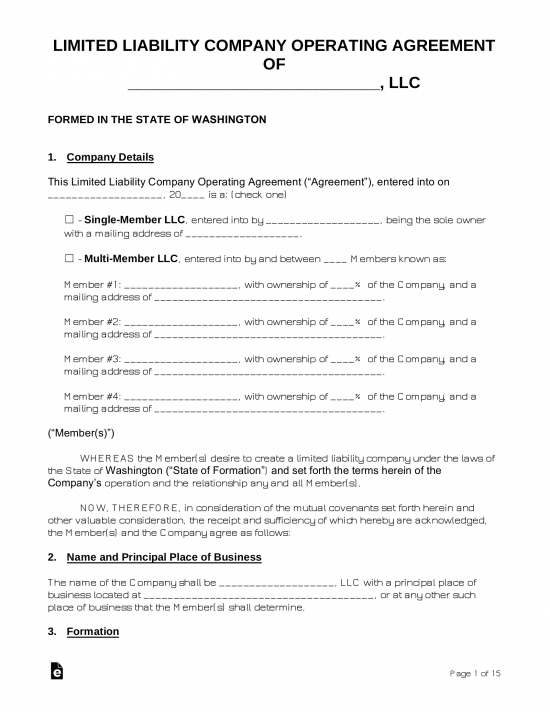
Step 5: Create an Operating Agreement

The next step for how to start an LLC in Washington is receiving the certificate of formation, which formally confirms the existence of your LLC in Washington. The state will mail this certificate to the Washington mailing address you provided within 1-3 working days of receiving your Articles of Organization (or similar document).
(image source: https://eforms.com/operating-agreements/wa/)

Step 6: Get an Employer Identification Number

The next step for how to create an LLC in Washington is getting your tax ID number. The Internal Revenue Service (IRS) will assign you an Employer Identification Number (EIN) in order to identify your LLC for taxes. 

An EIN, sometimes referred to as a Federal Employer Identification Number (FEIN) or Federal Tax Identification Number (FTIN), in nine digits and enables an LLC to file and manage taxes at the state and federal level, open a business bank account, and hire employees. You can obtain an EIN for free via the IRS online portal.

Step 7: File an LLC Franchise Tax and Public Information Report

Now that you know how to file an LLC in Washington, you need to know how to maintain it. Within 120 days after registering with the state it is required in the state of Washington that all corporations, nonprofits, LLCs, LPs, LLPs, and LLLPs file a Washington Annual Report. 

Each year, these reports must be filed with the Washington Secretary of State, Corporations & Charities Division, either online or by paper with a $10 filing fee. The filing processing time for online is immediate and 10-12 business days by mail.

NOTE: Filing Errors

Doing your due diligence and thoroughly researching how to set up an LLC in Washington can ensure a smooth set up process, although errors can occur. In these instances, if you register an LLC in Washington, and then discover a mistake in your filings, you should correct it as soon as possible by filing a Statement of Correction.

What are the Costs of Starting an LLC in Washington State?

How much is an LLC in Washington altogether? The cost to start an LLC in Washington is relatively low compared to other states. Here are the typical expected costs to register an LLC in Washington:

  • Business Name Reservation filing fee: $30
  • Certificate of Formation filing fee: $180 ($200 if online)
  • Washington Annual Report:  $10

Does Collective Help with Starting an LLC in Washington State?

Yes! You have the steps above on how to start an LLC in Washington State, but if all of the lists and paperwork sound somewhat overwhelming, you can always consider having Collective do all most of these formalities for you. Collective offers a smarter, more affordable way to get your LLC set up and running by  providing services that manage your LLC formation, monthly bookkeeping, accounting, taxes, and more.

Start your Washington State LLC with Collective and find out how much you could save.

Our website contains general information only and this information is not to be taken as legal, tax, or financial advice. You should consult with your attorney and/or tax advisor to get answers to your specific questions.

Join the community of self-employed experts

Collective handles the tax and accounting side of your business – so you have more time to focus on your passion. LLC formation, S Corp election, bookkeeping, monthly financial reporting and an average member tax savings of $10,000*. Estimate your tax savings to get started.

Start Tax Calculator

Common questions

How Much Does It Cost to Form an LLC in California?

Since you only need to form your LLC once, you’ll only pay the fees associated with forming the LCC one time. Here’s a list of fees you’ll pay to start your LLC in California:

Filing fees

You’ll pay two filing fees to form an LLC in California:

A $70 fee to file articles of organization with the California Secretary of State’s office
A $20 fee to file a Statement of Information, Form LLC-12, with the California Secretary of State.

LLC name costs

Although this is optional, you might choose to pay a $10 fee in order to reserve your preferred LLC name with the Secretary of State.

This prevents another business from registering the same name or a similar name before you have the chance to register your business. It’s also recommended that you conduct a trademark search to make sure that your LLC name doesn’t violate someone else’s trademark rights.

Costs of creating an operating agreement

Even though an operating agreement isn’t legally required, it’s highly recommended that you have one written for your LLC.

The best part is that there might not even be an additional cost involved with getting this done, especially if you join Collective. We provide you with a free LLC operating agreement that’s been written by a professional attorney.

If you decide to write your own customized operating agreement with the help of a lawyer, it could cost anywhere from $500 to $1,000.

Paperwork costs

The simple act of completing and filing all of the required paperwork for your LLC also comes with some costs.

Hiring an attorney to help you fill out and file your paperwork can cost a lot, with averages ranging from $500-$1,000.

Business license fees

Depending upon the nature of your business and where it’s located, you might also need to get a local business license from your city or county.

The cost varies widely, but for a small business, it’s usually $50 to $100.

How Much Does It Cost to Maintain an LLC in California?

Your work isn’t done—and you aren’t done paying fees—once your LLC is formed. Now you need to deal with ongoing maintenance expenses. It’s all just part of doing business.

Cost of registered agents

Having a registered agent, who will accept court papers and other important documents on your LLC’s behalf, is a great idea. The annual cost of having a registered agent is typically $75 to $150.

Statement of Information costs

Even after your business is up and running, you’ll be required to file a new Statement of Information with the California Secretary of State every two years. With that comes a $20 filing fee, so be sure to mark your calendar and set aside some money in your budget to take care of this.

Business license fees

Yep, we’re talking about business license fees again, because it doesn’t always end after you get your business license and paying the upfront fee. Oftentimes, you also have to periodically renew your business license. And that means paying a renewal fee.

Whether you have to renew your business license every year or more or less often, setting aside the money to pay the fee is a smart move.

Fictitious Name Statement fees

If you filed a fictitious name statement then you’ll need to renew that statement every five years. So, in addition to paying the fee for your first fictitious name statement, be prepared to pay the fee again when you need to renew it.

What About Taxes?

Taxes are another thing to consider when it comes to calculating the costs of running an LLC in California. And you can’t avoid them, even if you form your LLC in another state.

Even if you form your LLC in another state, if your LLC is located in California, you’ll have to register your out-of-state LLC in order to to do business in California. On top of that, you’ll be required to pay the same taxes and fees as any other California LLC.

Here’s the gist: California imposes special taxes and fees on LLCs that are organized in the state. LLCs are subject to two different taxes, both of which are paid to the California Franchise Tax Board.

Which LLC Costs Are Tax Deductible?

The good news is that all of these LLC costs are tax-deductible.

You can deduct up to $5,000 of the costs of forming your LLC in a single year. This includes:

The cost of completing articles of organization

LLC filing fees

The costs of drafting an LLC operating agreement

Attorney fees

Other fees you incur for setting up your business

Tags:
  • Guides
  • LLC

More on Business Formation

All Business Formation posts
Business Formation

S Corp Election Deadline: How and When to File Form 2553

For an existing business on a calendar year, the S Corp election deadline is…

Oct 8, 2026 · 9 min read
Business Formation

What Is an S Corp? A Complete Guide for Freelancers & Self-Employed

An S Corp is a federal tax status that a corporation or LLC can…

Oct 8, 2026 · 10 min read
Business Formation

How To Start an S Corp: A Step-by-Step Guide for the Self-Employed

An S Corp starts as a legal entity, not a company you build from…

Aug 19, 2026 · 10 min read
Business Formation

Simple Steps To Forming an LLC in Georgia: Your Comprehensive 2025 Guide

Are you thinking about taking control of your career and building something of your…

Jun 4, 2025 · 7 min read
Business Formation

How to Pay Yourself as a Business Owner (Without Wrecking Your Finances)

Never pay your rent from your business bank account.It sounds obvious, right? But countless…

Jun 2, 2025 · 7 min read
Business Formation

S Corp Application Form (2553)

Special Note: Only Real Pen Ink Signatures Allowed Overview Form 2553 is a foundational…

Dec 10, 2024 · 2 min read
Business Formation

How to Start an S Corp in New York

As a NY business owner, if you’re looking for a way to mitigate your…

Jun 26, 2024 · 12 min read
Business Formation

Owner’s Draw vs. Salary: Paying Yourself as a Business Owner

The way you set up your business has a ripple effect. Impacting everything from…

Jan 22, 2024 · 15 min read
Business Formation

Texas S Corp: What You Need to Know

If you call the Lonestar State home, or are considering moving there – well…

Jan 2, 2024 · 7 min read
Business Formation

S Corp in Florida: Is It the Right Choice for Your Business?

Like most solopreneurs in Florida, or elsewhere, you’re passionate about your business. After all,…

Nov 29, 2023 · 7 min read
Business Formation

What is an LLC?

An LLC, or Limited Liability Company, is a legal business structure that combines the…

Aug 17, 2023 · 10 min read
Business Formation

What is Accounting?

Accounting Definition What is accounting? Accounting is the process of recording, summarizing, analyzing, and…

Jul 14, 2023 · 8 min read
Business Formation

What is an EIN Number?

EIN (Employer Identification Number) Definition What is an employer identification number? An Employer Identification…

Jul 13, 2023 · 7 min read
Business Formation

Guide to Small Business Expense Tracking

So you’ve figured out how to start an LLC or other small business venture.…

Apr 19, 2023 · 5 min read
Business Formation

How to Start an LLC in Maryland: A Step-by-Step Guide

Starting an LLC in Maryland FAQs Why Start an LLC in Maryland? If you’re…

Apr 4, 2023 · 8 min read
Business Formation

How to Start an LLC in Colorado: A Step-by-Step Guide

Starting an LLC in Colorado FAQs Why Start an LLC in Colorado? If you’re…

Mar 31, 2023 · 7 min read
Business Formation

How to Start an LLC in Oregon: A Step-by-Step Guide

Starting an LLC in Oregon FAQs Why Start an LLC in Oregon? If you’re…

Mar 3, 2023 · 8 min read
Business Formation

How to Start an LLC in New Jersey: A Step-by-Step Guide

Starting an LLC in New Jersey FAQs Why Start an LLC in New Jersey?…

Feb 28, 2023 · 8 min read
Business Formation

How to Start an LLC in Texas: A Step-by-Step Guide

Starting an LLC in Texas FAQs Why Start an LLC in Texas? If you’re…

Feb 21, 2023 · 7 min read
Business Formation

How to Start an LLC in Florida: A Step-by-Step Guide

Starting an LLC in Florida FAQs Why Start an LLC in Florida? If you’re…

Feb 13, 2023 · 7 min read

About the author

Collective Editorial Team

Collective Editorial Team

The Collective Editorial Team is made up of writers, editors, and subject matter experts covering everything solopreneurs deal with — from tax, bookkeeping, and business formation to marketing, growing revenue, and the everyday realities of running a business solo. The team works closely with self-employed business owners to understand what they're actually navigating, and for technical content, leverages authoritative tax and regulatory sources to keep it accurate and current.

All articles by Collective Editorial Team

Best for S Corp owners

Payroll, books and filings in one membership

LLC Tier $199/mo · S Corp Tier $349/mo

Related

  • 10 Tax Mistakes That Cost Freelance Designers Thousands (and How to Fix Them)
  • 1099 Taxes: A Complete Guide for Freelancers & Contractors
  • Accounting and Tax Guide for Doctors

Latest

  • A New Era of Entrepreneurship
  • Collective Raises $100M for Full Stack AI Financial OS Powering the Solopreneur Revolution
  • The Vampire Expenses Draining Your Business

We’re glad you’re here!

First, tell us about your business

Net profit = Total revenue - total expenses

  1. Find total revenue. Add up all money your business earned from sales of goods or services during the year.
  2. Subtract your expenses. Deduct all business costs like supplies, rent, utilities, software, contractor payments, and loan interest.

An estimate is fine, you don't need exact figures.

W2 employees are people on your payroll

You withhold income tax, Social Security, and Medicare from their paychecks, and they get a W-2 form from you at the end of the year.

Don't count yourself (even if you pay yourself a salary) or 1099 contractors and freelancers.

I agree to Collective Terms of Service & Privacy Policy. Additionally, by providing phone number to continue, I agree to receive calls, incl. autodialed or prerecorded sales calls, from Collective.

Collective logo

We are experts in the unique needs and challenges of self-employed people and know that our confidence gives others confidence, too. Reach out to say hello and join our team.

We are experts in the unique needs and challenges of self-employed people and know that our confidence gives others confidence, too. Reach out to say hello and join our team.

Products

  • Business setup
  • Accounting
  • Invoicing
  • Payroll
  • Taxes
  • Business insurance
  • Health insurance
  • Support
  • Late S Corp election

Company

  • Home
  • Pricing
  • About us
  • Careers
  • Contact us
  • Partnerships

Resources

  • Blog
  • Guides
  • Help center
  • Testimonials
  • Press
  • Create with us

Legal/Support

  • FAQ
  • Terms of service
  • Privacy policy
  • Security policy

Compare

  • Compare all
  • Collective vs Lettuce
  • Collective vs LegalZoom
  • Collective vs TurboTax
  • Collective vs ZenBusiness

Collective provides a suite of tools, back-office support, and general information. Our services are not intended as tax, legal, or professional advice.

* Savings estimates reflect the average 2023 federal self-employment (SE) tax savings for Collective members with an S Corp tax election, based on business profits that would've otherwise been subject to SE tax. Actual savings will vary based on individual circumstances.

** Based on data sourced from Shopify blog, QBO Essentials, QBO Live, Gusto, Taxfyle, Intuit "Tax Pro" Research, LegalZoom and JustAnswer.com as of August 2025.

† Individual tax return packages are billed as an annual, one-time add-on fee.

© 2026 Collective Hub, Inc. All rights reserved