
• Skip to primary navigation
  • Skip to main content
Collective

Collective

A blog to help freelancers with taxes - Collective

What we offer

Business setup Form your business the right way Accounting Expert approved, powered by AI Invoicing Get paid faster, without the busywork Payroll Payroll made simple for S Corps Taxes Stress-free taxes for solopreneurs Business insurance Coverage for your business Health insurance Instant and affordable health coverage Support Human expertise + AI speed
Pricing Customers
About us Partnerships Careers We're hiring! Press
Blog Newsletter Webinars

Free tools

S Corp tax savings calculator Estimated tax & extension calculator Tax calendar S Corp admin cost calculator Freelance rate calculator Bill rate calculator
See all free tools →
Login
Business setup Accounting Invoicing Payroll Taxes Business insurance Health insurance Support
Pricing
Customers
About us Partnerships Careers We're hiring! Press
Blog Newsletter Webinars S Corp tax savings calculator Estimated tax & extension calculator Tax calendar S Corp admin cost calculator Freelance rate calculator Bill rate calculator See all free tools
Login
Resources / Small Business Hacks · 5 min read

Four Indispensable Personal Financial Identities To Help Increase Your Chances of Success

Enhance your success with these financial identities. Learn how they impact your journey and strategies to leverage them effectively.

Keisha Blair
Written by Keisha Blair
Eric Poole
Updated by Eric Poole
Published Dec 22, 2020 · Last updated Jul 10, 2024
On this page 4 sections
  1. The Minimalist
  2. The Maximalist
  3. The Risk Taker
  4. The Anxious Spender/Investor

AI Summary

AI-generated from this article. Not tax advice.

  • The Financial Identities Framework rests on four criteria: overall debt tolerance, risk profile, expectations of others, and inner expectations.
  • The Minimalist favors simple living, avoids debt, and tracks spending closely, exemplified by Warren Buffett's investing principles.
  • The Maximalist is a lavish spender driven by outward indicators of wealth, while the Risk-Taker takes goal-driven risk to build assets and hit milestones.
  • The Anxious Spender is conservative and risk-averse but tends to worry and feel inadequate about money decisions.
Table scrolls sideways →

In the first article in this series, we discussed why it’s important to embrace your own financial identity as an entrepreneur in order to be successful. Now, I’m going to offer a primer on the Financial Identities Framework I developed through the Certified Holistic Wealth TM Consultant Program and offered through the Keisha Blair Institute on Holistic Wealth.

After my husband died, I realized that I had only partially embraced my own financial identity. I am a Risk-Taker and he was a Minimalist. In any partnership (whether business or personal) it helps to understand your money motivations as well as your partners’.

Fully embracing your personal financial identity allows for self-awareness, self-advocacy and self-preservation. Understanding your partner’s financial identity helps with negotiation, accountability and keeping each other on track. It’s a win-win.

After my book was published, readers were coming forward to ask me what the financial identities were because they wanted to delve deeper and identify their personal financial identities. And many of these readers were business owners – primarily solopreneurs interested in learning more so they could apply these lessons in their business endeavors.

The Financial Identities Framework has four main criteria:

  • Overall Debt Tolerance: Level of appetite in taking on debt when assessing financial decisions.
  • Risk profile: Level of appetite in taking on additional risk in assessing financial decisions.
  • Expectations of others: Willingness to yield to the expectations of others, like spending money to go out with friends.
  • Inner expectations: The expectations we place on ourselves, like keeping our new years’ financial resolutions. 

The most successful, wealthiest, happiest and most productive people aren’t those from a particular financial identity, but rather those who have figured out how to harness the strengths of their financial identity, counteract the weaknesses and build holistically wealthy lives.

As an entrepreneur, knowledge and wisdom gained from the Financial Identities Framework, can help you make better financial decisions, understand your money motivations, embrace your financial strengths, use your time more productively and suffer less stress.

Here’s a quick summary of the four financial identities.

KEISHA BLAIR’S FINANCIAL IDENTITIES FRAMEWORK
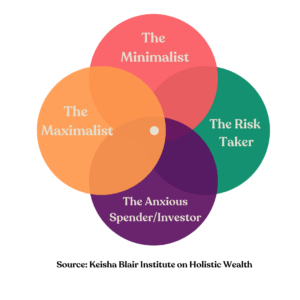
The Minimalist

“Simple Living/Keep It Simple”

The minimalist satisfies inner expectations and doesn’t yield to the expectations of others, with either their spending or investing habits. You’re a frugal person and astute with tracking your spending and budgeting. The minimalist doesn’t take on debt and, if they do, it’s minimal and paid back in full as soon as possible.

Signs that you’re a minimalist:

  • Your mantra in life is simple living and you prefer simplicity in everything.
  • You don’t feel like you need to follow the crowd with your spending or investment habits.
  • You’re willing to take on only minimal risk on consumer spending because your mantra is simple living.

When I think about a prominent Minimalist – Warren Buffet comes to mind. With a net worth of over $90 billion, his debt and investment principles are sound.

One of his principles is “don’t ever get into debt unless you’ll profit from it”. He lives in the same house he bought in 1958 for $31,500, and drives cars that were damaged by hail.

Warren Buffet’s “20-Slot” rule of financial investing advocates for simplifying your life through a highly focused approach to investing. The 20 slots represent all the investments you can make in a lifetime, which requires directing your energy to fewer tasks.

The Maximalist

“The Lavish Spender/Go large or Go home”

With both spending and investment habits, the maximalist’s motivation is outward indicators of wealth (like real estate, beauty or fashion).

Signs that you’re a maximalist:

  • You’re the life of the party and you love making others happy – even if it means going over budget to do it (maybe a lot over budget sometimes?).
  • You like the best things or the most lavish things in life (like designer shoes), you drive an expensive car and your home is Architecture Digest-worthy.
  • Your Instagram feed is the envy of your town and your vacations are lavish.

When I think of Maximalists, Kim and Cloe Kardashian, and Kylie Jenner come to mind, who are all entrepreneurs and television stars of the hit series “Keeping Up With The Kardashians”. Other fictional TV characters that have maximlist qualities , albeit in a more extreme form, are Carrie Bradshaw, a freelancer, from “Sex and the City” and Rebecca Bloomwood from “Confessions of a Shopaholic”.

Take the quiz to find out your financial identity!

Get help with your self-employed income

The Risk Taker

“Always on the Lookout for the Next Deal”

Risk-Takers take on more risk than average in an effort to accumulate more assets and investments, and to further certain financial, entrepreneurial and lifestyle goals that they’ve outlined.

Signs that you’re a risk-taker:

  • You’re meticulous at planning for big money milestones such as starting a business or retirement.
  • Your risk-taking isn’t fueled by self-indulgence but is goal-driven.
  • You prefer to hit certain money milestones by a certain age or life stage.

When I think of prominent risk takers, Oprah Winfrey comes to mind. With a net worth of $2.6 billion Oprah Winfrey grew up poor and, by taking risks, transformed her famous talk show “The Oprah Winfrey Show” into a lifestyle brand, and is a self-made billionaire.

Thanks to Collective, I don’t have to worry about bookkeeping, taxes and other government related tasks and can focus 100% on my work. If you’re self-employed and need help with tax, bookkeeping and ongoing support, all-in-one place, you’ll love Collective!

Arjun Dev Arora

Strategy, Venture, Technology

The Anxious Spender/Investor

“Money equals Stress/Anxiety”

The Anxious spender/investor is as the name suggests: a conservative, risk-averse personality but with the added layer of being worried about money and a tendency to become anxious about making money decisions.

Signs you’re an anxious spender/investor:

  • You’re always worried about ending up poor or not having enough money for a rainy day
  • You question, worry and feel inadequate about your money decisions.
  • Your number one worry and concern in life is money-related

The fictional character of Earnest “Earn” Marks from the FX series Atlanta portrays this well. Other prominent TV stars who are risk-takers include investors on Shark Tank, including Mark Cuban, Barbara Corcoran and Lori Greiner or in the case of Canada, any of the TV stars on CBC’s Dragons Den, including Arlene Dickinson, Michele Romanow and Manjit Minhas.

Still not sure which financial identity is yours? Take this quick quiz to find out.

Now that you know your financial identity, in the final article in this series, we outline how to hack your Business-of-One by embracing your personal financial identity. We also highlight stumbling blocks with each financial identity and outline some productivity hacks to solve these issues.

Our website contains general information only and this information is not to be taken as legal, tax, or financial advice. You should consult with your attorney and/or tax advisor to get answers to your specific questions.

Get help with your self-employed income

Collective handles the tax and accounting side of your business – so you have more time to focus on your passion. LLC formation, S Corp election, bookkeeping, monthly financial reporting and an average member tax savings of $10,000*.

Get Started

More on Small Business Hacks

All Small Business Hacks posts
Blog

Unlocking the Zone of Genius: What the Right Support Actually Looks Like for Solopreneurs

Running a business alone means wearing every hat, all the time. The invoicing hat,…

Aug 10, 2026 · 4 min read
Blog

The S Corp Owner’s Mid-Year Check-In: Is Your Structure Doing What It Should?

If you’re running your business under an S Corp election, mid-year is a worthwhile…

Jun 11, 2026 · 5 min read
Blog

The Sole Proprietor’s Mid-Year Check-In: Is Your Setup Still Working for You?

Most people who start working for themselves don’t sit down and choose a business…

Jun 11, 2026 · 6 min read
Blog

Self-Employed Retirement Plan Limits Just Changed for 2026: Here’s What’s New

The IRS adjusts retirement plan contribution limits most years, and 2026 brings increases across…

Jun 10, 2026 · 7 min read
Blog

Self-Employed Retirement Plans: 2025 Contribution Limits and Your Best Options

When you work for yourself, no one is automatically setting aside money for your…

Jun 10, 2026 · 4 min read
Blog

Your LLC Turns One. Here’s What to Do Next.

One year in means something. You have real income, real expenses, and at least…

May 20, 2026 · 6 min read
Blog

Business Expenses for Social Media Influencers

We LOVE our members that are crushing it as social media influencers. One common…

Dec 10, 2024 · 5 min read
Blog

Meal and Entertainment Deductions

Business meals are a common expense, but what is tax deductible can be tricky…

Dec 10, 2024 · 3 min read
Blog

Differences Between Employee and Independent Contractor

If you’re a business owner, you’ll likely come to a point where you need…

Mar 20, 2024 · 6 min read
Blog

Should I Hire a 1099 Contractor or W-2 Employee?

As your business expands, you might need more help than your current capacity allows.…

Mar 13, 2024 · 6 min read
Blog

 How to Build Business Credit

Most people are familiar with the concept of credit scores. Major credit bureaus track…

Mar 4, 2024 · 5 min read
Blog

How To Handle Business Inventory

If your business carries inventory, effective inventory management is critical. Whether you’re running a…

Feb 20, 2024 · 7 min read
Blog

How to Take Parental Leave When You’re Self-Employed

Welcoming a child is exciting, and when you work for yourself, it can also…

Nov 6, 2023 · 5 min read
Blog

The 6 Lead Generation Mistakes to Avoid In Your Solo Consulting Business

This blog is written by guest author Melisa Liberman. Melisa has been an independent…

Oct 4, 2022 · 10 min read
Blog

How To Establish An Effective Lead Generation Routine As An Independent Consultant – A Case Study

It’s common for independent consultants to miss an important step when designing their lead…

Jun 8, 2022 · 9 min read
Blog

Tips for Creatives to Overcome Isolation and Loneliness

Being a Business-of-One has plenty of perks (hello having full control over when you…

Dec 8, 2021 · 4 min read
Blog

How to Turn a Referral Program Into a Main Source of Income

When I discovered Collective almost three years ago, I had little idea of what…

Nov 10, 2021 · 5 min read
Small Business Hacks

How to improve your payments workflow

As a creator, doing the work is often the easy part. Getting paid? Well,…

Sep 29, 2021 · 4 min read
Small Business Hacks

Want a sustainable business? Try diversifying your income

I’m sure you’ve heard that the average millionaire has 7 streams of income. I…

Sep 9, 2021 · 5 min read
Blog

7 Tips for Successfully Hiring Your First Freelancer

Learning how to find and hire the right help to scale my business has…

Aug 27, 2021 · 9 min read

About the author

Keisha Blair

Keisha Blair

Keisha Blair is the bestselling author of Holistic Wealth: 32 Life Lessons To Help You Find Purpose, Prosperity and Happiness and founder of the Keisha Blair Institute on Holistic Wealth, which offers the Certified Holistic Wealth Consultant Program for entrepreneurs and professionals. Her work has been featured in The New York Times, Forbes, The Wall Street Journal, Harvard Business Review, and Yahoo Finance. Find more at www.keishablair.com.

All articles by Keisha

Best for S Corp owners

Payroll, books and filings in one membership

LLC Tier $199/mo · S Corp Tier $349/mo

Related

  • Unlocking the Zone of Genius: What the Right Support Actually Looks Like for Solopreneurs
  • The S Corp Owner’s Mid-Year Check-In: Is Your Structure Doing What It Should?
  • The Sole Proprietor’s Mid-Year Check-In: Is Your Setup Still Working for You?

Latest

  • Webinar Recap: Open Enrollment & How Solos Can Choose the Right Plan (November 18, 2026)
  • 2027 Tax Brackets Are Out: What Solopreneurs Need to Know
  • Who Bankrolls a Company of One? 

Finally, a newsletter for ambitious solopreneurs

Bringing you our business-of-one newsletter about the best solopreneur strategies, news, and more.

You’re subscribed

Look for the next issue of Business of One in your inbox.

We’re glad you’re here!

First, tell us about your business

Net profit = Total revenue - total expenses

  1. Find total revenue. Add up all money your business earned from sales of goods or services during the year.
  2. Subtract your expenses. Deduct all business costs like supplies, rent, utilities, software, contractor payments, and loan interest.

An estimate is fine, you don't need exact figures.

W2 employees are people on your payroll

You withhold income tax, Social Security, and Medicare from their paychecks, and they get a W-2 form from you at the end of the year.

Don't count yourself (even if you pay yourself a salary) or 1099 contractors and freelancers.

I agree to Collective Terms of Service & Privacy Policy. Additionally, by providing phone number to continue, I agree to receive calls, incl. autodialed or prerecorded sales calls, from Collective.

Collective logo

We are experts in the unique needs and challenges of self-employed people and know that our confidence gives others confidence, too. Reach out to say hello and join our team.

We are experts in the unique needs and challenges of self-employed people and know that our confidence gives others confidence, too. Reach out to say hello and join our team.

Products

  • Business setup
  • Accounting
  • Invoicing
  • Payroll
  • Taxes
  • Business insurance
  • Health insurance
  • Support
  • Late S Corp election

Company

  • Home
  • Pricing
  • About us
  • Careers
  • Contact us
  • Partnerships

Resources

  • Blog
  • Guides
  • Help center
  • Testimonials
  • Press
  • Create with us

Legal/Support

  • FAQ
  • Terms of service
  • Privacy policy
  • Security policy

Compare

  • Compare all
  • Collective vs Lettuce
  • Collective vs LegalZoom
  • Collective vs TurboTax
  • Collective vs ZenBusiness

Collective provides a suite of tools, back-office support, and general information. Our services are not intended as tax, legal, or professional advice.

* Savings estimates reflect the average 2023 federal self-employment (SE) tax savings for Collective members with an S Corp tax election, based on business profits that would've otherwise been subject to SE tax. Actual savings will vary based on individual circumstances.

** Based on data sourced from Shopify blog, QBO Essentials, QBO Live, Gusto, Taxfyle, Intuit "Tax Pro" Research, LegalZoom and JustAnswer.com as of August 2025.

† Individual tax return packages are billed as an annual, one-time add-on fee.

© 2026 Collective Hub, Inc. All rights reserved